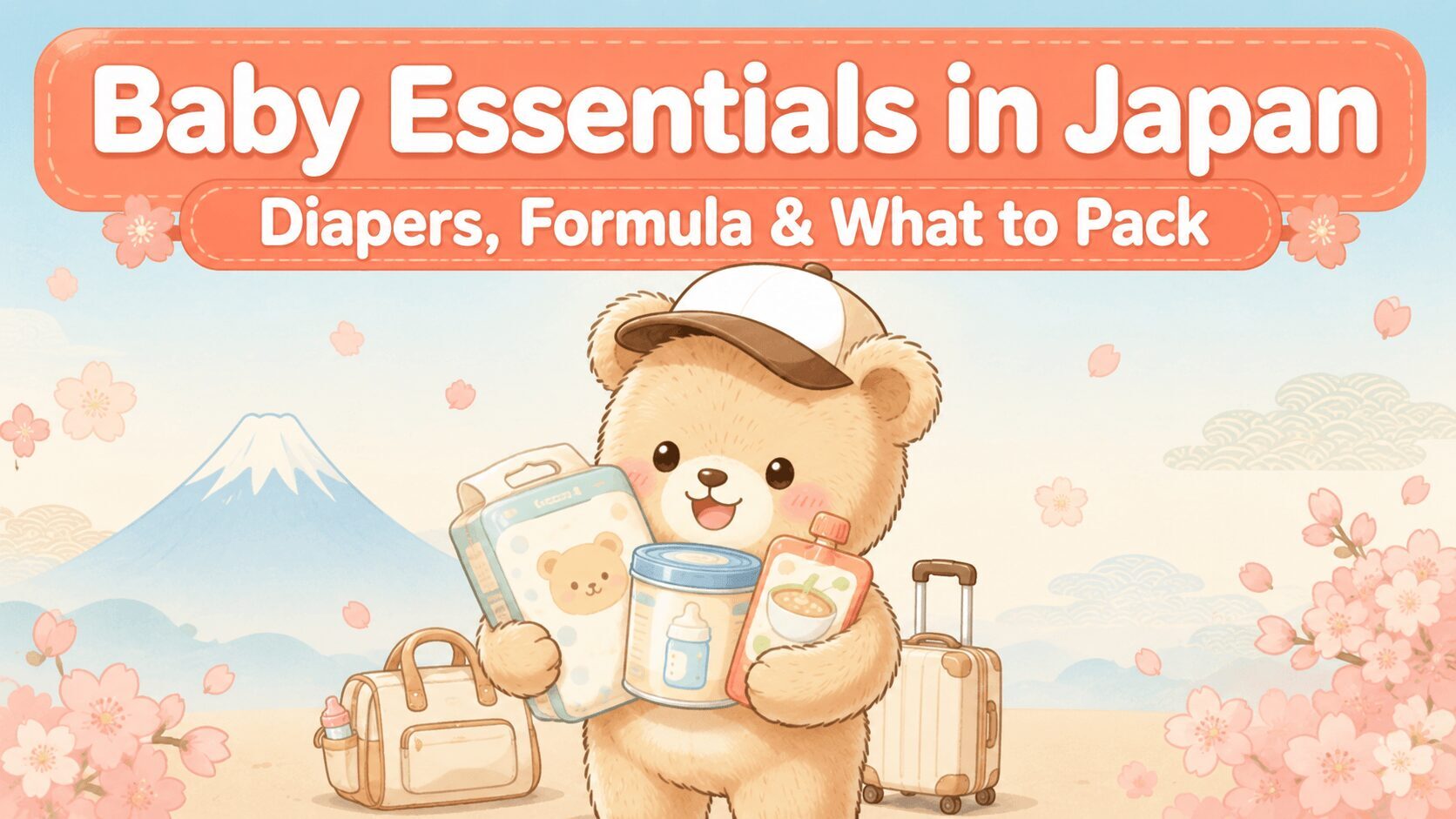
Is half your suitcase currently filled with diapers? Are you googling “can I buy formula in Japan” at 2am? Been there — and I have great news: you can leave most of it at home.
I’m Travel Mama Bear 🐻 — a mom living in Japan. Japanese drugstores carry world-class diapers, formula, and baby food on every corner. The real packing skill isn’t bringing everything — it’s knowing what you truly can’t buy here and leaving space for the rest.
What you’ll learn in this article:
- What to bring from home (the truly irreplaceable items)
- What to buy in Japan (and skip packing entirely)
- What to set up on your phone before your flight
- A suitcase strategy that leaves room for souvenirs
- Your first 24 hours in Japan — the drugstore run routine
This article contains affiliate links. If you book or buy through them, we may earn a commission at no extra cost to you.
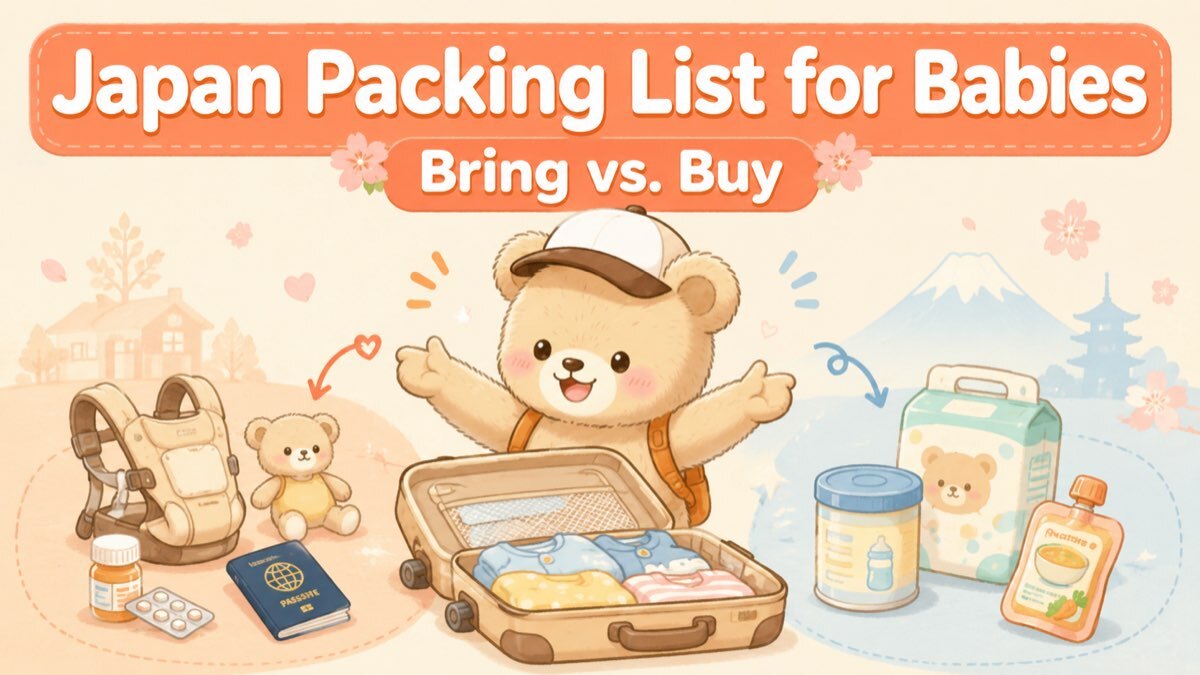
⚡ Quick Answer — Bring vs. Buy Cheat Sheet
| ✅ Bring from Home | 🛒 Buy in Japan |
|---|---|
| Prescription & fever medicine (syrup type) | Diapers (pack only 3–5 days’ worth) |
| Allergy-specific formula | Regular formula — powder, cubes & liquid |
| Kids’ passports (needed for IC cards!) | Baby wipes (Japanese ones are amazing) |
| Your usual baby carrier | Baby food pouches |
| The one comfort toy/blanket | Baby snacks, barley tea & drinks |
| Travel insurance documents | Bibs, stroller hooks & travel gadgets (¥100 shops!) |
🐻 Travel Mama Bear says: “The golden rule: if losing it would ruin your trip, bring it. If a drugstore sells it, buy it here. Japan will take care of the rest — I promise!”
✅ What to Pack from Home — The Irreplaceables
💊 Medicines & Health Items
- Your child’s usual fever reducer (syrup or chewable) — a quick culture note: Japanese pediatricians often prescribe suppositories for baby fevers, so the syrup type you know may be hard to find. And since taking a little one to a clinic in an unfamiliar country (in another language) is genuinely stressful, packing your familiar fever medicine from home is the easiest way to handle a midnight fever with confidence
- All prescription medicines — in original packaging, with enough for the whole trip plus a few extra days
- Allergy medication & EpiPens if your child needs them
- A simple health record — vaccination history and any conditions, in case you need a doctor
🛂 Documents — Don’t Forget the Kids’ Passports!
Obviously your kids need passports to enter Japan — but here’s what most parents don’t know: you’ll need your child’s passport again inside Japan to buy a Kids’ IC card (the half-price transit card for ages 6–11). It can only be purchased at staffed ticket counters with the child’s ID.
👉 Full details in our Japan Train Guide for Families — IC cards, strollers, Shinkansen and more.
🧸 Comfort Items
The one item Japan cannot sell you: your child’s favorite lovey. The specific bear, the specific blanket, the pacifier brand they’ll actually accept. Pack it, pack a backup if one exists, and guard it with your life. 🐻
👶 Baby Gear
- Your usual baby carrier — essential in Japan. When the station elevator is hiding at the far end of the platform, or the train is crowded, folding the stroller and switching to the carrier saves the day
- Stroller: bring your own lightweight one if you have it. Japan is stroller-friendly, but stations involve elevator hunts — a light, one-hand-foldable stroller is ideal. (Airport rental services also exist if you’d rather not fly with one)
🛒 What to Buy in Japan — Skip Packing These!
Here’s your suitcase-space liberation list. All of these are sold at drugstores on practically every corner in Japan — often better quality than what you’d bring:
- 👶 Diapers — Merries, Moony, Pampers Japan. World-class quality, about ¥1,000–¥3,000 for a pack of 50–70 (price varies by brand and quality — organic/premium lines run a bit higher). Pack only 3–5 days’ worth
- 🍼 Formula — powder, pre-measured cubes (genius for travel), and ready-to-drink liquid formula
- 🥣 Baby food — huge pouch selection, no heating needed
- 🧻 Baby wipes — high quality, big packs, 99% pure water options for sensitive skin
- 🎒 Travel gadgets — stroller hooks, straw caps, disposable bibs, odor-blocking diaper bags… many under ¥110 at Daiso
We wrote a complete guide with real store photos, brand comparisons, and how to read Japanese diaper sizes 👇
📱 Pre-Flight Setup — Do These Before You Board
The smartest packing happens on your phone. Fifteen minutes at home saves hours of airport stress with a tired baby:
- 📶 Set up your Japan eSIM (Airalo) — install it at home, activate on landing. No SIM counter queues while holding a cranky baby. Bonus: tethering lets the kids’ tablets stream on long train rides
- 🌐 Download Google Translate’s Japanese offline pack — the camera mode reads diaper packages, medicine labels, and menus instantly
- 🗺️ Download offline Google Maps for your destination cities
- 📱 iPhone users: add Welcome Suica Mobile or Mobile ICOCA to your wallet — tap through the train gates the moment you land
- 📍 Save the drugstore nearest your hotel in Google Maps — trust me on this one (see “First 24 Hours” below)
👉 We tested Airalo’s speeds across Japan — Shinkansen, subways, Disney: Airalo Japan eSIM Review (Real Speed Data)
📶 Get Your Japan eSIM on Airalo — Works from the Moment You Land
🧳 Suitcase Strategy — Think Round Trip
- Outbound: 3–5 days of consumables + the irreplaceables + empty space
- Use compression pouches for diapers — they shrink a bulky diaper stash to half the volume. (Even a large zip-top bag works in a pinch — just press the air out before sealing.)
- Return trip: that empty space fills up fast — Japanese baby wipes, cute diaper designs, ¥100 shop gadgets, and jinbei (traditional summer outfits — cool, comfy, and the ultimate souvenir photo) all make brilliant take-homes 🐻
🛬 Your First 24 Hours in Japan
Here’s the routine that makes everything smooth:
- Land → eSIM activates → you have maps and translation immediately
- Head to your hotel and settle in — don’t overplan day one
- The drugstore run: visit that saved drugstore near your hotel. Stock up on diapers, wipes, baby food, and snacks for the week
- Bonus stop: if there’s a Daiso or Seria nearby, grab the ¥110 travel gadgets — stroller hooks, straw caps, wipe lids
🐻 Travel Mama Bear says: “That first drugstore run is honestly kind of fun — it’s your first taste of everyday Japan, and the baby aisle will genuinely impress you. Give yourself 30 relaxed minutes and enjoy it!”
❓ FAQ
- QCan I bring a stroller on the plane?
- A
Yes — most airlines let you gate-check a stroller for free. Check your airline’s size rules. In Japan, a lightweight one-hand-fold stroller is ideal for station elevators.
- QCan I bring liquid formula on the flight?
- A
Baby formula and baby food are exempt from the standard liquid limits when traveling with an infant — declare them at security. (Rules vary slightly by country, so check your departure airport’s guidelines.)
- QCan I buy children’s medicine at Japanese pharmacies?
- A
Basic children’s medicines exist, but labels are in Japanese and formulations differ (remember the suppository culture!). For anything your child takes regularly, bring it from home. For medical advice, Japan has a pediatric hotline (#8000), though English support varies by prefecture. In a true emergency, dial 119 — Japan’s equivalent of the US 911 — for fire and ambulance; many areas offer interpreter support for non-Japanese speakers, so 119 is often your most reliable option if #8000 isn’t in English where you are.
- QHow much should I budget for baby supplies in Japan?
- A
Very little! Diapers run about ¥1,000–¥3,000 for a big pack of 50–70 (depending on brand and quality — organic/premium lines run a bit higher), baby food pouches ¥100–200 each, and travel gadgets ¥110 at Daiso. Buying here is usually cheaper than checking an extra bag.
🗺️ Ready to Pack (Light)?
Pack the irreplaceables, set up your phone, and let Japan’s drugstores handle the rest. Your suitcase stays light, your back stays happy, and there’s room for all the adorable things you’ll want to bring home. You’ve got this! 🐻
🏨 First Things First: Pick a Baby-Friendly Base
Choose a hotel within a few minutes of a drugstore or baby store, and that “first 24 hours” drugstore run becomes effortless — restock diapers and wipes, then dash back for naps. We’ve stayed at (and researched) dozens of family hotels in each city, so start here:
More to plan your trip: