“Where am I supposed to nurse the baby while sightseeing?”
“What if I need to change a diaper in the middle of Kyoto?”
Here’s the secret nobody tells first-time visitors: Japan is quietly one of the best countries on Earth for baby rooms. Department stores, malls, stations, and theme parks are filled with free, spotless facilities — private nursing booths, padded changing tables, hot water for formula, even microwaves. Most tourists never discover they exist.
I’m Travel Mama Bear 🐻, a mom raising kids in Japan, and I’ve used these baby rooms more times than I can count. This guide shows you exactly how to find them, what’s inside, and the etiquette that makes everything smooth.
This article contains affiliate links. If you book or buy through them, we may earn a commission at no extra cost to you.
⚡ Quick Answer
| Question | Answer |
|---|---|
| Where are baby rooms? | Department stores, malls, baby stores, major stations, theme parks |
| How much do they cost? | Completely FREE |
| What’s inside? | Private nursing booths, changing tables, hot water, sinks, microwaves |
| Can dads go in? | Baby room: yes / Nursing booths inside: usually moms only |
| How do I find them? | Look for 授乳室 signs or use the MamaPapaMap app (English OK) |
🍼 What Is a Japanese Baby Room?(授乳室)
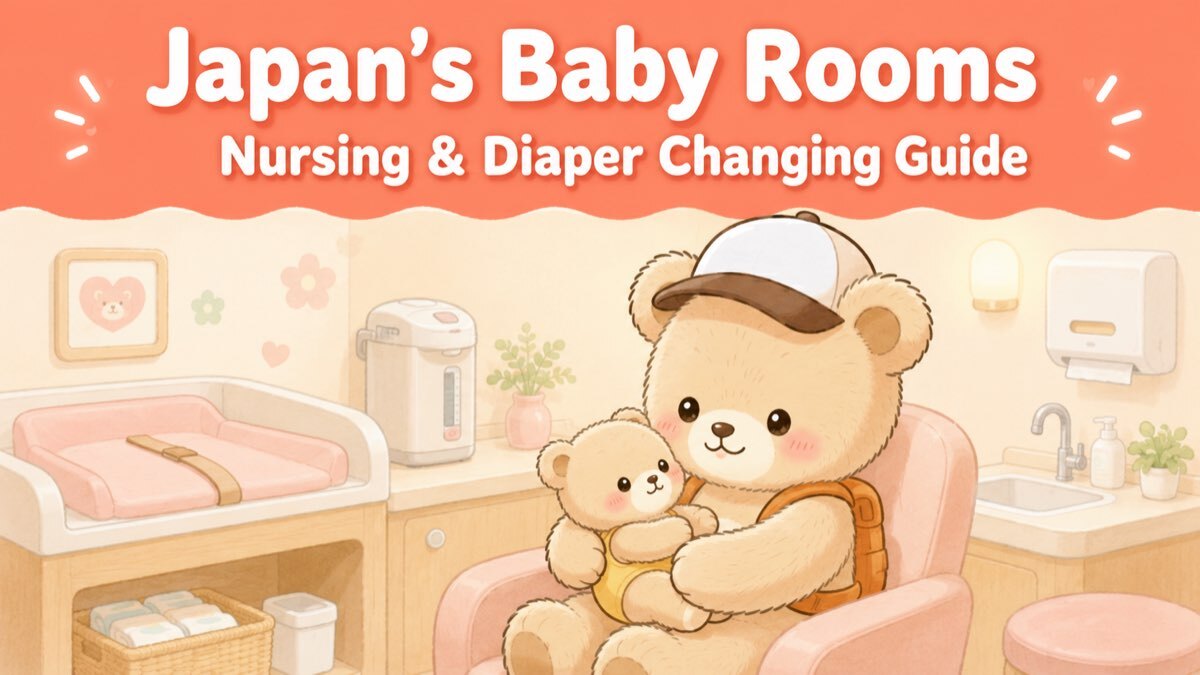
The Japanese word to know: 授乳室 (junyū-shitsu) — literally “nursing room.” Often labeled “Baby Room” (ベビールーム) in larger facilities. Here’s what a typical one contains:
- 🤱 Private nursing booths — fully partitioned little rooms, invisible from outside
- 🚼 Padded changing tables — clean and cushioned
- ♨️ Hot water dispensers for preparing formula
- 🚰 Sinks for washing hands and bottles
- 🔥 Microwaves for warming baby food (in many locations)
- 🎰 Vending machines selling diapers, wipes, and baby drinks
- ⚖️ Baby scales and sometimes small play areas
And yes — all of this is free. No purchase required, no time limit pressure, no questions asked.
🐻 Travel Mama Bear says: “The nursing booths are fully private little rooms — nobody can see in, so you can nurse in complete peace. There’s a hot water dispenser, so with just a bottle and formula cubes you can make milk on the spot. And Japanese baby rooms are impressively clean and hygienic — you can use them with total confidence. Every foreign mom friend I’ve shown one to has been amazed!”
🔍 How to Find Baby Rooms — Signs, Apps & Tricks
The Signs to Look For
- 授乳室 — the kanji for “nursing room.” Screenshot this and pattern-match!
- ベビールーム / Baby Room — common in malls and stations
- 🍼 Icons — a baby bottle, a parent holding a baby, or a diaper symbol on floor maps and signs
MamaPapaMap — The App Every Traveling Parent Needs ★
This free app (English, Japanese & Chinese) maps nursing rooms and changing stations across all of Japan — with parent-submitted photos, reviews, and filters for hot water, microwaves, stroller rental, and more. Tourist reviews consistently say it “made our trip.” Download it before you fly.
Google Maps & Information Desks
- Search “nursing room” or “baby room” in Google Maps — coverage is decent in big cities
- In department stores, just ask the information desk: “Junyū-shitsu wa doko desu ka?” (Where is the nursing room?) — or simply say “baby room” with a questioning look. They’ll point you right to it
📍 Where to Find Baby Rooms — Reliability Ranking
🥇 Department Stores — Almost Guaranteed
Daimaru, Takashimaya, Isetan, Mitsukoshi — every major department store has at least one baby room, usually on the kids’ clothing floor (upper floors). These are the five-star hotels of baby rooms: spotless, well-stocked, and rarely crowded on weekdays.
🥈 Shopping Malls
AEON, LaLaport, and city malls like Namba Parks in Osaka all have baby rooms. Mall facilities are typically well-equipped — changing tables in the restrooms, baby chairs in the toilets, and roomy accessible multipurpose toilets you can bring the stroller into.
🥉 Baby Stores
Akachan Honpo and Babies R Us have excellent baby rooms — and you can restock diapers and formula while you’re there. Two birds, one stop. (See our guide to buying baby essentials in Japan.)
🚉 Major Stations & the Shinkansen
Large stations (Tokyo, Shin-Osaka, Kyoto) have baby rooms inside or near the gates. On the Shinkansen itself, there’s a multipurpose room that can be used for nursing — important detail: it’s kept locked, so ask a crew member to open it when you need it. It’s meant for genuine need (nursing, feeling unwell), not casual use.
👉 More Shinkansen family tips in our Japan Train Guide for Families.
🎢 Theme Parks & Airports
Tokyo Disney Resort and USJ have dedicated Baby Centers with nursing rooms, changing stations, and formula prep areas. Airports (Narita, Haneda, KIX) have baby rooms in every terminal.
🛖 mamaro — The Baby Care Pod
Keep an eye out for mamaro — compact private baby care booths popping up in stations and malls across Japan. They lock from inside, welcome both moms and dads (one person at a time), and are completely free — some even have power outlets. If a full baby room isn’t nearby, a mamaro pod might be.
👨 Rules & Etiquette — Dads, Privacy & Culture
Can Dads Use the Baby Room?
Here’s how it typically works: the baby room itself welcomes dads — changing tables, hot water, feeding chairs are all fair game. But the nursing booths tucked in the back are usually women-only (look for 女性専用 signs). Gender-neutral nursing rooms have been growing since 2020, but the women-only setup is still the norm.
🐻 Travel Mama Bear says: “Our family power move: divide and conquer! Dad changes the toddler’s diaper in the main area while I nurse the baby in the private booth — everything done in one stop. When you’re mid-sightseeing with tired kids, finishing the pit stop in one go is everything.”
Nursing in Public — Know the Culture
Honest cultural note: open breastfeeding in cafes, parks, or trains is not common practice in Japan. It’s not illegal — it’s just not the norm, and you may feel eyes on you. The local approach: use a nursing room, or a nursing cape if you must feed on the go. With baby rooms this good and this common, most parents find they rarely need to nurse in the open anyway. And here’s a stress-free trick: keep some ready-to-drink liquid formula on hand — you can feed your baby anywhere, anytime, with zero setup and zero eyes-on-you worry. (More on Japan’s genius liquid formula in our baby essentials guide.)
- Keep booth time reasonable when others are waiting
- Leave the changing table as clean as you found it
- Take used diapers with you unless a diaper bin is provided
🚼 Just Need a Diaper Change? Here’s Where
- Restroom changing tables — standard in women’s restrooms at malls and stations, and increasingly in men’s restrooms too
- Multipurpose toilets (多目的トイレ) — the large accessible restrooms found in stations, malls, and public buildings almost always have a fold-down changing bed. Roomy enough to bring the stroller inside
- ⚠️ Konbini toilets rarely have changing tables — plan around malls and stations instead (see our konbini survival guide)
- 💡 Pack odor-blocking diaper bags (¥110 at Daiso) — public trash cans are rare in Japan, so you’ll often carry used diapers until you find a bin. These bags make that a non-issue (see our packing guide)
📱 Before You Go
- 📲 Download MamaPapaMap before your flight — it’s free and works in English
- 🌐 Google Translate offline pack — for reading signs and asking for directions
- 📶 Data from the moment you land — you’ll be searching for baby rooms on the go, so reliable internet is essential. We use Airalo’s Japan eSIM. Read our tested review with real speed data
📶 Get Your Japan eSIM on Airalo — Works from the Moment You Land
- QAre baby rooms really free?
- A
Yes — 100% free, no purchase necessary. They’re a public service that Japanese facilities provide as standard.
- QWhat if the nursing booth is occupied?
- A
Waits are usually short. Department stores often have multiple booths, and weekday mornings are quietest. The MamaPapaMap app can show you the next-nearest option.
- QWhere can I get hot water for formula?
- A
Baby rooms almost always have a hot water dispenser. Hotels provide kettles in rooms, and konbini staff will often share hot water too. Pair it with formula cubes and you can make a bottle almost anywhere.
- QCan I nurse on the train?
- A
On regular trains, it’s uncommon — most parents use a nursing cape or wait for a station baby room. On the Shinkansen, ask the crew to unlock the multipurpose room.
🗺️ Ready to Explore
Once you know baby rooms exist — and how absurdly good they are — Japan transforms into one of the easiest places in the world to travel with a baby. Nurse in peace, change in comfort, and enjoy your trip. Japan’s got your back. 🐻
🏨 First Things First: Pick a Baby-Friendly Base
Stay near a department store or big mall and a five-star baby room is always minutes away. That’s exactly why hotel location matters so much with a baby. We’ve stayed at (and researched) dozens of family hotels in each city:
More to plan your trip: