※ Written from ten years of raising kids in the Kansai region, right next door to Kyoto. Our family has done the Kiyomizu-dera climb with our children. I have visited Kinkaku-ji and Ginkaku-ji myself, but before I had kids — so those notes mix first-hand impressions with research on the family side. Fushimi Inari and Arashiyama are research-based, and marked as such. Tour details and prices verified August 2026. This article contains affiliate links.
Kiyomizu-dera. Kinkaku-ji. Fushimi Inari. The Arashiyama bamboo grove. Every Kyoto guide shows you the same four postcards — and almost none of them tell you what those four spots feel like with a four-year-old in tow.
Here is the uncomfortable truth we have learned living next door to Kyoto for ten years: those four icons sit in four different corners of the city. Stringing them together by bus and train is a full-time job for adults. With kids, the plan usually breaks somewhere around icon number two.

One day, four icons, small kids — it IS possible. You just have to choose the right way to move between them. 🌸
- 🎯 The Short Answer
- ⛩️ The Four Icons — and What Each One Is Actually Like With Kids
- 🗺️ Why the Golden Route Is Brutal With Kids on Public Transport
- 🚐 Option 1: The Private Tour Day (Best for First-Timers)
- 📊 Three Tours Worth Shortlisting (Honest Comparison)
- 🚃 Option 2: DIY by Train — Two Icons a Day, and Never the City Bus
- 📶 One Thing Every Option Needs: Mobile Data
- ❓ FAQ
- 📝 The Bottom Line
🎯 The Short Answer
If this is your only day in Kyoto: book a private car tour with hotel pickup. It turns roughly 3–4 hours of buses, transfers and taxi queues into car time where your kids can nap, and it is the only realistic way to see all four icons in one day with small children.
If you have two or more days: do it yourself by train and on foot — never by city bus, at a pace of two icons per day — it is cheaper, and Kyoto rewards slow travel. (Our separate kid-paced Kyoto itinerary covers that version — linked below.)
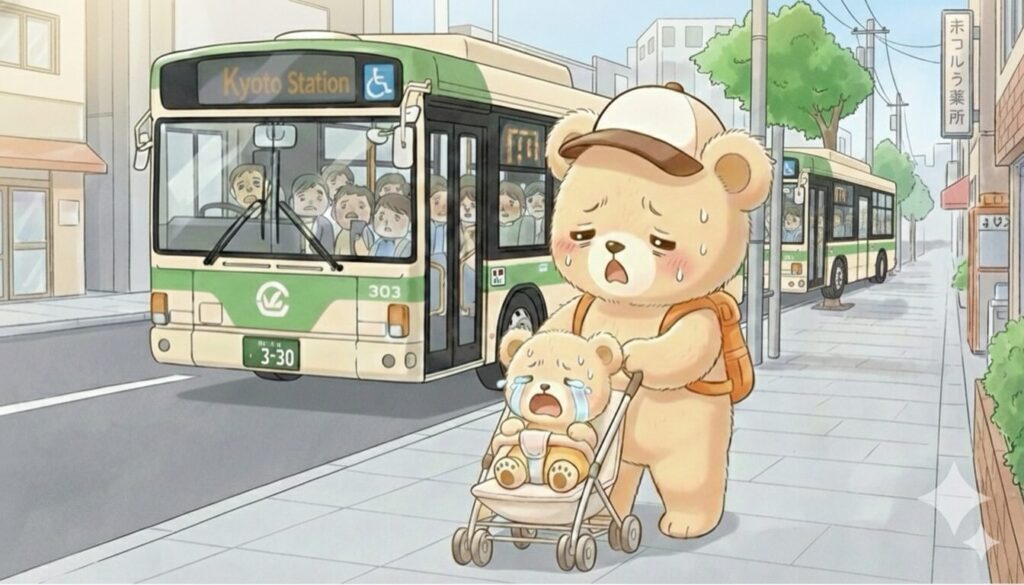
Why we keep saying “never the bus”: Kyoto is a city of 1.4 million residents that receives tens of millions of visitors a year, and both groups ride the same handful of bus routes. The result is buses that arrive already full. With a stroller you cannot simply roll on — you fold it one-handed while holding your child, your bag and a handrail, standing, for twenty minutes. Add traffic that makes the timetable meaningless, and stops where you routinely watch one or two buses go past before you can squeeze on. Trains have none of these problems: they run to the second, they have space, and the major stations have elevators.
⛩️ The Four Icons — and What Each One Is Actually Like With Kids
Before the logistics, here is what you are actually going to see — and, more usefully, how each one lands with children.
Kiyomizu-dera — the temple on stilts
A 1,200-year-old temple whose main hall juts out over the hillside on a platform of enormous wooden pillars, built without a single nail. You approach it uphill through Ninenzaka and Sannenzaka, stone-paved lanes lined with sweet shops and pottery stores.
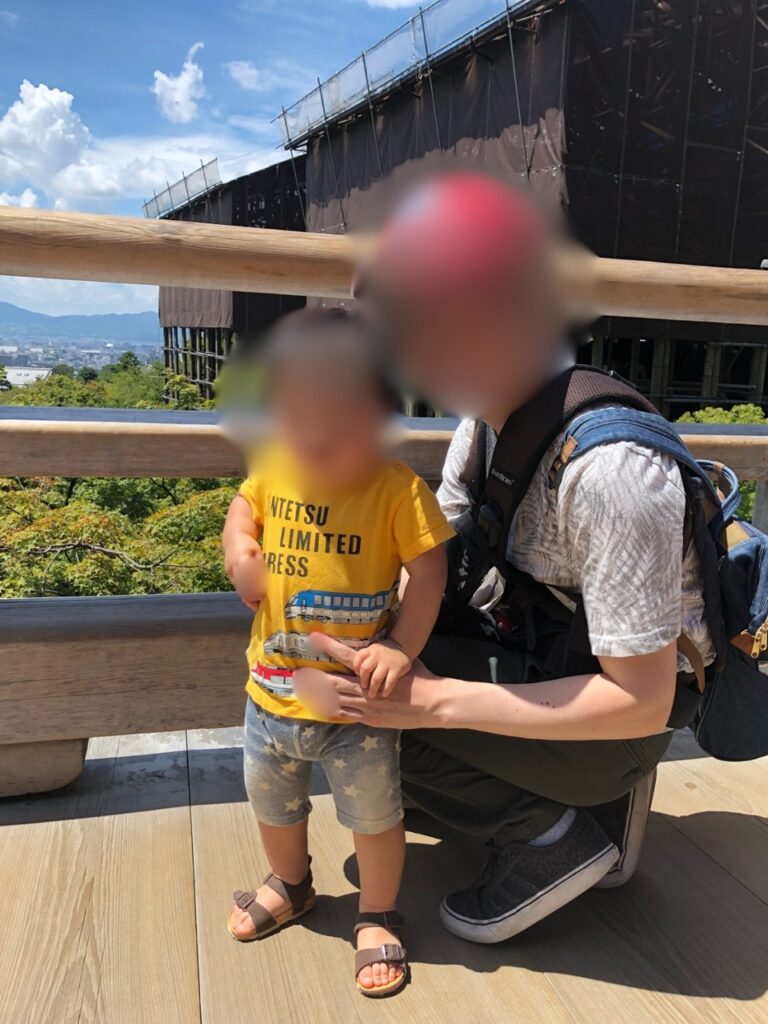
With kids (our own visit): the wooden stage genuinely impresses them — ours decided it looked “like a pirate ship.” The climb does not. It is a sustained slope on uneven stone, so bring a carrier, not a stroller.
Don’t skip the waterfall. Below the main hall, spring water falls in three separate streams into a pool — this is Otowa-no-taki, and it is the single best part of Kiyomizu-dera for children. You queue, take a long-handled cup from a rack, reach it under one of the streams and drink. The temple itself says the three streams are associated with academic success, health and love. Popular belief adds a rule the temple does not officially state: choose only one — drink from two or three and the greed supposedly cancels your wish out.
Which is where the fun starts, because your children will almost certainly drink from all three. Ours would have. Let them. Watching a small person solemnly work their way along the entire waterfall, hedging every bet at once, is the memory you will actually keep from the day.
And leave time for the lanes. Ninenzaka and Sannenzaka — the sloping stone streets you climbed on the way up — are lined with small shops, and they are genuinely fun rather than tourist-tat: matcha soft serve and grilled rice crackers to eat as you walk, character stores, sweet shops, and kimono rental studios (many will dress children too, which turns the walk into the day’s best photographs). Budget an hour here on the way back down. The lanes do as much work on a tired child as any temple.
👉 English-speaking staff on site daily — steps from the Yasaka Pagoda
👘 Check Kimono Rental Plans on Klook(from ¥2,500 · ⭐4.9, 1,000+ booked · free cancellation)
🚻 The practical bits: the temple officially confirms diapers can be changed in its accessible toilets, inside the grounds. No lockers up here — leave big bags at your hotel or a Kyoto Station locker before the climb.
Kinkaku-ji — the golden pavilion
A three-storey pavilion covered in gold leaf, mirrored in the pond in front of it. It is a one-way garden loop and, honestly, a short visit: you look, you photograph, you walk the circuit, you leave. Around 30–40 minutes is normal.
One expectation to reset first: having been there myself (before I had children), the pavilion is smaller than the photographs suggest. What the photographs do not oversell is the beauty. It is genuinely, almost unreasonably photogenic — with cherry blossom, in autumn colour, under snow, it is impossible to take a bad picture of it. That is the honest frame for a family visit: this is a place you go to look and photograph, not a place that will entertain your children.
With kids: the easiest of the four to physically manage. The path is flat, wide and gravel-and-pavement, so a stroller works. The flip side is that a golden building holds a small child’s attention for roughly ninety seconds — a history-minded older child may be fascinated, but a toddler will not be. Go, get the photograph your family will keep for twenty years, and move on without guilt.
🚻 The practical bits: public toilets sit by the garden loop, but changing tables are not a given — do the diaper stop before you arrive. No lockers, so keep this a light-bag visit.
Ginkaku-ji — the quiet one (worth it if you have a spare half-day)
Not part of the four-icon route, but if your trip has room, the “Silver Pavilion” on the eastern side of the city is where you actually feel wabi-sabi — the Japanese sense of beauty in restraint and imperfection. There is no silver on it. The garden is the point, and it is one of the most beautiful in Japan.
With kids: a raked garden is, predictably, not a toddler’s idea of a good time — but two things save it. First, the sand sculptures: a raked “sea” of ripples and a perfect cone of sand about 180cm tall, which children find genuinely strange and fascinating. Second, the viewpoint on the hillside at the eastern edge of the grounds — climb the steps and the whole pavilion, garden and the city of Kyoto open up below you. Because it sits away from the main circuit, it stays quiet even when the entrance is busy, and the climb itself turns the visit into a small expedition.
Practical notes: allow 30–45 minutes for the grounds, or about an hour including the viewpoint. The path up is stairs and slope — no stroller, and carry or hold hands with a new walker, as parts of the hillside path have limited railings. There is nothing designed for children up there: it is a view, not a playground.
Fushimi Inari — the tunnels of red gates
Thousands of vermilion torii gates standing shoulder to shoulder, forming tunnels that wind up a sacred mountain. The full mountain circuit takes 2–3 hours; the famous photographs everyone recognises all happen in the first fifteen minutes.
With kids: the biggest hit of the four — walking through the gates feels like a tunnel game, and children love it. Two rules: arrive before 9:00, because the crowds build with startling speed and the gate tunnels are narrow, and do not attempt the full summit loop. Walk the lower tunnels, turn around, everyone stays happy. There are steps and uneven slopes, so this is another carrier stop rather than a stroller one.
Where to turn around — and the game to play there. The natural turning point is Okusha Hōhaisho, the small shrine building just beyond the first stretch of gates: roughly 15–20 minutes there and back from the main hall. Behind it stand a pair of stone lanterns with round stones on top, called omokaru-ishi (“heavy-light stones”). You make a wish, then lift the stone: if it feels lighter than you expected, the wish is said to come true. Children take this extremely seriously, and it gives them a task at exactly the point where a temple visit would otherwise start to drag.
Look out for the foxes too — kitsune are the messengers of this shrine, and stone foxes holding keys and scrolls in their mouths stand everywhere. Fox-face wooden plaques hang near the shrine for visitors to draw on, which is a five-minute activity most small children will happily spend fifteen minutes on.
🚻 The practical bits: coin lockers wait by the main approach (roughly ¥200–500) and at both train stations, so you can walk the gates hands-free; the Keihan station also lists baby facilities. Toilets cluster near the entrance and main shrine — go before the tunnels, because they get scarce on the mountain.
Arashiyama — the bamboo grove (and the river town)
A green corridor of towering bamboo on the western edge of the city, attached to a riverside town with boat rides, rickshaws and a monkey park on the hill above.
With kids: the grove path is flat and paved — the one genuinely stroller-friendly icon, though it is also short (about ten minutes end to end). Togetsukyo Bridge and the riverbank are stroller-friendly as well, so this is the easiest of the four to do with a baby. The grove is best early: by midday the path becomes a slow-moving crowd, and a stroller stops being an advantage.
The monkeys are the real attraction — with one catch. Iwatayama Monkey Park sits on the hill above the town, and around 120 Japanese macaques roam free at the top, where you can feed them from inside a mesh-walled hut (the humans are in the cage, not the monkeys — which children find hilarious). The catch is the access: a 20-minute climb up a mountain path with steps. Strollers cannot go up and are left at the bottom, so anyone too small to walk it needs carrying. Admission runs about ¥600 for adults and ¥300 for children aged 4–15. If your children are four and up, this is the memory of the day; with a baby, weigh the climb honestly.
Two easy extras beside the station: the Kimono Forest, a walkway of hundreds of illuminated pillars wrapped in kimono fabric, which takes ten minutes and photographs beautifully; and the riverside itself, where rental boats and the seasonal sightseeing train give tired legs a rest.
🚻 The practical bits: both stations rent coin lockers (a whole bank at the Randen Arashiyama station, about ¥400–800; coin-only ones by the JR Saga-Arashiyama gates), and the station buildings are your most reliable toilet stop — go before the bamboo grove, which has none.
To be precise about what is first-hand: Kiyomizu-dera we have done with our own children. Kinkaku-ji and Ginkaku-ji I have seen myself, but pre-kids — the impressions are mine, the family logistics are researched. Fushimi Inari and Arashiyama we have not yet done as a family, so those sections come from ten years of living next door in Kansai plus current research, not from pushing our own stroller through them. Facility details (toilets, lockers) are researched as of August 2026 — layouts change, so treat them as a guide.
🗺️ Why the Golden Route Is Brutal With Kids on Public Transport
Look at a map and the problem jumps out. Kiyomizu-dera guards the eastern hills. Kinkaku-ji sits in the far northwest. Fushimi Inari is south of the station. Arashiyama is out west, practically a separate town. There is no train line that links them; the connections are city buses that fill to standing room by mid-morning, where a stroller must be folded while you hold your child, your bag and the handrail with your remaining hand.
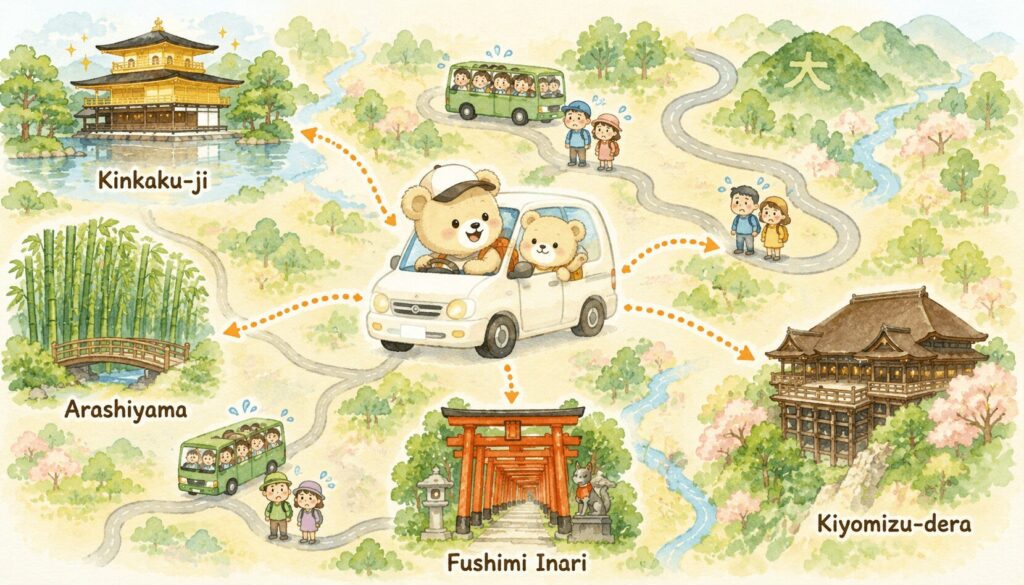
And the connections that do exist are not equal. Kinkaku-ji in particular sits away from every train line — reaching it without a car realistically means a city bus, which is exactly the transfer we tell families to avoid. That single stop is the reason most one-day, four-icon plans quietly fall apart.
🚐 Option 1: The Private Tour Day (Best for First-Timers)
The tour we would shortlist first runs the exact route in this guide — Kiyomizu-dera, Kinkaku-ji, Fushimi Inari and Arashiyama in one 10-hour loop — with an English-speaking driver-guide and pickup straight from your hotel in Kyoto, Osaka or Kobe. Between stops, your kids nap in the van instead of melting down on a packed bus. That single difference is worth more than any guidebook tip we can offer.
One nuance worth knowing before you book: this is a driver-guide format, not a walking lecturer. At some stops — Kiyomizu-dera, for example — you explore on your own while the guide handles the parking, timing and the next leg. With kids, we would call that a feature: nobody is pacing your family through a temple.
The math for a family: ¥81,250 covers the whole group of 1–3, with a per-person fee for additional guests, and children under 4 join free. For a group of up to three, that flat rate is the whole story; a family of four adds one per-person fee at checkout — the booking screen shows your exact total before you pay. What you are buying either way: four hours of your only Kyoto day, returned.
👉 The exact route in this guide, done for you — hotel pickup included
🚐 Check Dates & Book the Kyoto Private Tour(¥81,250 per group of 1–3 · English-speaking driver-guide · ⭐4.6, 300+ booked)
📊 Three Tours Worth Shortlisting (Honest Comparison)
We compared the private day tours on Klook the way we compare hotels — by track record, not photos. These three survived:
| Tour | Route | Hours | Pricing | Track record |
|---|---|---|---|---|
| Kyoto Private Tour (this guide’s route) | Kiyomizu · Kinkaku-ji · Fushimi Inari · Arashiyama | 10h | ¥81,250 / group of 1–3 | ⭐4.6 (31) · 300+ booked |
| Kyoto & Nara Private Guided Tour | Kyoto highlights + Nara Park deer | 10h | from ¥12,500 / person | ⭐4.6 (63) · 700+ booked |
| Uji Matcha & Nara Day Tour | Uji tea town + matcha experience + Nara | 9h | ¥51,250 (see booking screen) | ⭐4.7 (36) · 800+ booked |
🦌 If your kids care more about deer than temples
The Kyoto & Nara combination is the most-booked private option of the three, and for good reason: Nara’s bowing deer are the single most reliable kid-pleaser in the entire Kansai region. One honest note from our research: the operator’s overall positive-review rate sits at 84% — solid, but a notch below the others — so skim the most recent reviews for your travel dates before booking.
👉 Kyoto highlights + Nara’s bowing deer in one day
🦌 See Prices: Kyoto & Nara Private Tour(from ¥12,500 per person · hotel pickup · 700+ booked)
Planning the Nara half of that day yourself instead? Our full Nara Park family guide covers the deer etiquette, stroller routes and where the bold deer actually are: 👇

🍵 If this is your second Kyoto trip (or your kids love doing, not looking)
The Uji matcha tour swaps temple-counting for hands-on culture: kids grind their own matcha in the town that grows Japan’s best tea, then feed the deer in Nara. If your children are past the “another temple?” stage, this is the one that turns Kyoto from scenery into a story they will retell.
👉 Grind your own matcha in Uji, then meet Nara’s deer
🍵 Check the Uji Matcha & Nara Day Tour(⭐4.7 · 800+ booked · 9 hours)
🚃 Option 2: DIY by Train — Two Icons a Day, and Never the City Bus
If you have two or more Kyoto days, skip the tour money and go slow. Two rules keep everyone smiling. First: two icons per day, never four. Second, and this is the one we tell every visiting family: build your route out of trains and walking only, and treat the city buses as a last resort. Kyoto’s buses run permanently full — you will be folding a stroller one-handed while holding your child and a handrail, and that single transfer can drain a parent for the rest of the day. Two pairings that work without them:
- Day A — Fushimi Inari early + Arashiyama after lunch: JR Inari station sits literally at the shrine entrance, so be at the gates before 9:00 (the crowds arrive with brutal speed) and walk only the lower torii tunnels. Then ride back through Kyoto Station and out west on the JR Sagano line to Saga-Arashiyama — station to bamboo grove on foot, no bus at any point.
- Day B — Kiyomizu-dera morning + Gion & Nishiki Market afternoon: the day we have done ourselves. Take the Keihan line to Kiyomizu-Gojo and walk up (carrier, not stroller), then come back downhill through the old lanes into Gion and on to Nishiki Market — the whole day links up on foot and one train line.
Full honesty, as always on this blog: the Kiyomizu day is our own experience with our kids; the Fushimi–Arashiyama pairing is planned from ten years of local knowledge and deep research, not yet from our own stroller wheels.
For a complete slow-paced version — aquarium, railway museum, the spots Kyoto kids actually rate highest — our kid-paced itinerary is here: 👇

📶 One Thing Every Option Needs: Mobile Data
Whichever way you go, Kyoto runs on your phone: live bus timetables, Google Maps walking routes through unmarked lanes, and messaging your driver at pickup time. Sort your eSIM before you land:
You’ll rely on your phone all day — Google Maps navigation, real-time train info, bus timetables, and messaging when your group splits up. We used Airalo Japan eSIM on our family trip and it activated the moment we landed at the airport. No SIM card swap, no standing in line at the airport counter.
✅ Your tour pickup messages and e-vouchers all arrive on your phone — working data from minute one pays for itself
✅ Install the app before you fly — activates on arrival
✅ 15% OFF with code MAMABEARNEW
📱 Read Our Airalo Japan eSIM Review + 15% OFF Code →
❓ FAQ
- QIs a private Kyoto tour worth it for a family?
- A
If you have exactly one Kyoto day and want the famous icons, yes. Public transport between all four eats roughly 3–4 hours of your day, most of it standing on crowded buses. A private car converts that into nap time for the kids. The base rate covers up to three people; a fourth adds a per-person fee shown on the booking screen before you pay. (Details and prices are in the private tour section above.)
- QAre these tours really run in English?
- A
Yes — all three tours shortlisted in this guide operate with English-speaking driver-guides. Confirm the language option on the booking screen before you pay; some operators also offer Chinese or other languages.
- QDo private tours provide child car seats?
- A
Japan’s child-seat law exempts hired vehicles with professional drivers, so the vans can legally carry your children without one. One honest note: the exemption is a legal technicality, not a safety endorsement — Japanese safety bodies still recommend seats for under-6s. Message the operator right after booking; many can arrange one on request.
- QCan we do the Golden Route ourselves with a stroller?
- A
Two icons a day, yes — as long as you build the route from trains and walking. The Arashiyama bamboo path and Kinkaku-ji’s garden loop roll along comfortably with a stroller. For the Kiyomizu-dera approach and Fushimi Inari, we recommend a baby carrier over a stroller — the slopes, steps and crowds make carrying far easier on everyone — and stay on Fushimi’s lower gate tunnels with small kids. The awkward one is Kinkaku-ji: it has no nearby station, so DIY visitors face a packed city bus with a stroller — which is precisely the trip a private car removes.
- QWhich cities do the tours pick up from?
- A
The main tour in this guide collects you from hotels in Kyoto, Osaka or Kobe — so you can day-trip the Kyoto icons even if your family’s base is an Osaka hotel. Check your exact hotel is inside the pickup zone on the booking screen.
📝 The Bottom Line
One Kyoto day with kids: buy back the transit hours with a private tour, and spend them at the icons instead. Two or more days: go slow, two icons a day, mornings first. Either way — be at Fushimi Inari before 9:00, carry (don’t push) up the Kiyomizu hill, and let the snack lanes do the motivating on the way down. Kyoto with kids is not harder than other cities. It just punishes bad transit plans more.
🏨 Where to sleep for this exact plan: two picks from our hotel guide that fit a one-day icons run best — both at Kyoto Station, which means an easy tour pickup and painless trains.
Hotel Granvia Kyoto — built directly into the station building, so your tour van, trains and rainy-day backup plan are all an elevator ride away. Kids 6 and under sleep free.
\ Station-direct = zero stress. Rooms go fast! /
MIMARU Kyoto Station — apartment-style suites with a kitchen and real space for the whole crew; the practical pick for bigger families and three-generation trips.
\ Kitchen suites for big families are limited! /
If the hotel itself is going to be the treat of the trip — the five-stars that genuinely welcome children: 👇

Want a more budget-friendly pick instead? Every family-tested Kyoto hotel we recommend: 👇