The first time I navigated a Japanese train with two kids, a stroller, and three overstuffed bags, I stood at the ticket gate for a solid minute with absolutely no idea what to do. Sound familiar?
Here’s the good news: once you know a few key things, Japan’s trains become the easiest, most stress-free way to get around with kids. Travel Mama Bear 🐻 has done this more times than I can count — here’s everything I wish someone had told me before that first trip.
What you’ll learn in this article:
- IC card types and how to buy them (including kids’ cards)
- Are strollers allowed on trains? How to find elevators
- How much does train travel cost for families?
- Tips for riding the Shinkansen with kids
- Osaka subway tips and how to get to USJ
- Our secret weapon for keeping kids happy on long train rides 🐻
👉 Planning your route? Osaka Family Itinerary
👉 Kyoto Family Itinerary
👉 Nara Park Family Guide
This article contains affiliate links. If you book or buy through them, we may earn a commission at no extra cost to you.
- ⚡ Quick Reference — Start Here!
- 💳 IC Cards — Your Most Important Travel Tool
- 👶 Strollers on Japanese Trains
- 🎫 Train Fares for Families
- 🚄 Riding the Shinkansen with Kids
- 🚇 Subway Tips for Families — Tokyo & Osaka
- 📱 Apps to Download Before You Go
- 📶 Staying Connected — Your eSIM Options
- ❓ Frequently Asked Questions
- 🗺️ Ready to Explore
⚡ Quick Reference — Start Here!
| Topic | Quick Answer |
|---|---|
| Best IC card | Tokyo arrival: Welcome Suica / Kansai arrival: ICOCA |
| Kids’ fares | Elementary school students: half price / Pre-school: free on local trains |
| Strollers allowed? | Yes — avoid rush hour |
| Rush hour to avoid | Weekdays 7:30–9:30 / 17:00–19:00 |
| Shinkansen luggage space | Book the last-row seat |
| Shinkansen ticket | IC card alone won’t work — separate ticket required |
| Best navigation app | Google Maps (turn on Wheelchair Accessible filter) |
| Internet on the go | Airalo eSIM recommended — see eSIM section below ↓ |
💳 IC Cards — Your Most Important Travel Tool
What Is an IC Card?
An IC card is a prepaid touch-and-go card for riding trains, buses, and subways in Japan. Just tap it at the gate and you’re through — no need to buy individual tickets every time. And it’s not just for trains: you can use it at convenience stores, vending machines, and more. Think of it as your all-in-one Japan wallet.
Transportation you can use with an IC card
- ✅ Local trains (JR, private railways, subways)
- ✅ Buses (on participating routes)
- ✅ Monorails and trams (on participating routes)
- ⚠️ Shinkansen → IC card alone is NOT enough. A separate ticket is required (more on this later)
Other places you can use your IC card
- ✅ Convenience stores (7-Eleven, Lawson, FamilyMart)
- ✅ Vending machines
- ✅ Station coin lockers
- ✅ Some taxis and restaurants
Which IC Card Should I Get? (Adults)
There are several IC card options, but they all work the same way and can be used nationwide. The two things that matter: your phone type and which airport you’re arriving at.
📱 iPhone Users: Set It Up Before You Leave Home!
If you have an iPhone, you can add an IC card to your phone. No matter where you’re flying into Japan, you can set everything up at home before your flight. The moment you land, you’re ready to tap through the gates — no need to hunt for a card at the airport.
Option 1: Welcome Suica Mobile (App)
A dedicated app created by JR East specifically for foreign visitors.
| Item | Details |
|---|---|
| Compatible devices | iPhone only |
| Language | English supported |
| Validity | 180 days |
| Top-up | Overseas credit cards accepted |
| Where to buy | Anywhere — even before you leave home |
| Refund | Not available |
Option 2: Mobile ICOCA (Apple Wallet)
Add ICOCA directly to your Apple Wallet.
| Item | Details |
|---|---|
| Compatible devices | iPhone only |
| Language | Mainly Japanese |
| Validity | No expiry |
| Top-up | Visa/Mastercard/Amex/JCB (some overseas cards may not work) |
| Where to buy | Anywhere — even before you leave home |
| Refund | Not available |
🤖 Android Users: Buy a Physical Card at the Airport or Station
Overseas Android phones don’t have the FeliCa chip used by Japan’s IC card system, so mobile IC card apps won’t work. Pick up a physical card when you arrive.
Arriving at Narita / Haneda / Tokyo → Welcome Suica (Physical Card)
A special version of Suica designed for foreign visitors by JR East. Works nationwide just like a regular Suica.
| Item | Details |
|---|---|
| Deposit | None (regular Suica requires ¥500) |
| Validity | 28 days from purchase |
| Where to buy | Narita/Haneda airports and select JR stations in Tokyo only |
| Refund | Not available |
| Passport | Not required |
Arriving at Kansai Airport / Osaka / Kyoto → ICOCA (Physical Card)
IC card issued by JR West. Works nationwide, so you can use it in Tokyo too.
| Item | Details |
|---|---|
| Deposit | ¥500 (refundable) |
| Validity | No expiry |
| Where to buy | Kansai Airport and ticket machines at JR West major stations |
| Refund | Available (at Midori no Madoguchi counter) |
| Passport | Not required |
| Payment | Cash only |
Adult IC Card Summary: Which One Should I Choose?
| Situation | Recommendation |
|---|---|
| iPhone user (any arrival airport) | Welcome Suica Mobile or Mobile ICOCA |
| Android user arriving at Narita/Haneda/Tokyo | Welcome Suica (physical card) |
| Android user arriving at Kansai Airport/Osaka/Kyoto | ICOCA (physical card) |
Kids’ IC Cards — Completely Separate from Adults
| Card | Where to buy | What you need |
|---|---|---|
| Kids’ Suica (incl. Welcome Suica for children) | Narita/Haneda airports, select JR stations in Tokyo, Midori no Madoguchi counter | Child’s ID (passport) |
| Kids’ ICOCA | Midori no Madoguchi counter in Kansai only (NOT available at ticket machines) | Child’s passport |
- Parents can buy on behalf of the child — the child doesn’t need to be present, as long as you have their passport
- Named cards only (no anonymous kids’ cards available)
- Kids’ cards cannot be used at adult ticket gates (and vice versa)
How to Top Up a Kids’ IC Card
- Top up with cash at station ticket machines or IC card charge machines
- Top up with cash at the register at convenience stores (7-Eleven, Lawson, FamilyMart)
Children Under School Age — No Card Needed, It’s Free!
- Local trains, subways, and buses are free for young children traveling with an adult — up to 2 young children per adult (the 3rd child onward pays the child fare)
- However, if your child occupies a reserved or unreserved seat on the Shinkansen or express train, a child fare applies
- Children sitting on a parent’s lap ride free
How to Use Your IC Card
- Tap your IC card on the “IC” marked reader at the ticket gate
- Families with strollers or wheelchairs: use the wide gate (wider than the standard gates)
- If your balance runs low, top up at a charge machine before the gate
- You can also top up at convenience stores (cash only)
- Mobile versions can be topped up anytime with a credit card
👶 Strollers on Japanese Trains
The Short Answer: Yes, You Can!
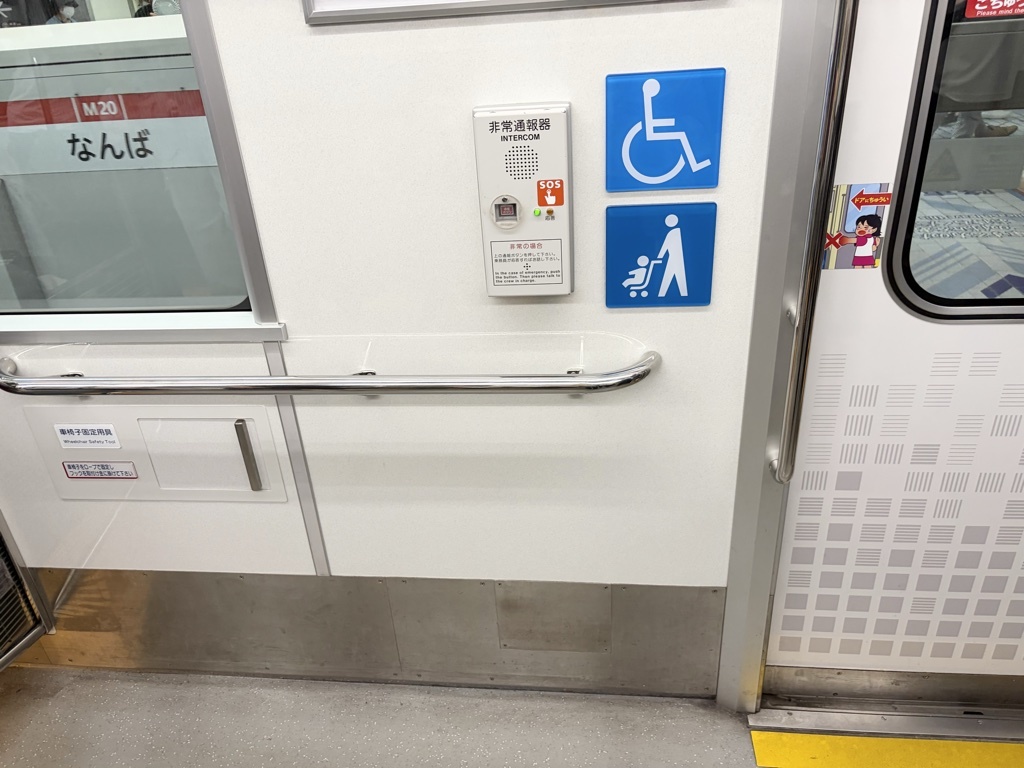
In Japan, there’s no law requiring you to fold your stroller on trains. However, it’s considered good manners to fold it during crowded times. Both Tokyo and Osaka trains have stroller and wheelchair spaces at the ends of train cars — though not on every line or every car, so look for the markings when you board.
Tokyo Metro
Every Tokyo Metro station has elevator access, but in practice it’s often just one elevator tucked away at the far end of the platform — nowhere near the exit you need. Always use Google Maps with the Wheelchair Accessible filter to get elevator-friendly routes. Sometimes it’s actually faster to exit the station, walk above ground, and re-enter at a different entrance than to navigate the underground corridors.
Osaka Metro
The Osaka Metro Midosuji Line clearly marks stroller and wheelchair spaces on the train cars, making it relatively easy to find the right spot. That said, some Osaka stations have fewer elevators than Tokyo, so always check your route on Google Maps in advance.
Avoid Rush Hour!
Honestly, rush hour with a stroller is really tough. Avoid these times on weekdays:
- Morning rush: 7:30–9:30
- Evening rush: 17:00–19:00
Weekends and holidays are much more comfortable.
Finding Elevators
Around 90% of major stations in Japan have elevators — but they’re often in hard-to-find spots, so give yourself extra time.
- Turn on the “Wheelchair Accessible” filter in Google Maps → it automatically shows you elevator-friendly routes
- Ask any station staff: “Where is the elevator?” — they’ll be happy to help
- Build in an extra 15 minutes when you know you’ll need an elevator
Stroller Tips
- Look for train cars with the stroller/wheelchair symbol — these have the designated spaces
- In a crowded train, the realistic option is to fold the stroller and switch to a baby carrier
- Use the space near the doors
🎫 Train Fares for Families
Age Categories
| Category | Definition | Fare |
|---|---|---|
| Adult | Age 12+ / Junior high school students and above (12-year-olds still in elementary school pay child fare) | Full fare |
| Child | Age 6+ / Elementary school students (6-year-olds who haven’t started school yet pay infant fare) | Half of adult fare |
| Infant | Age 1+ / Pre-school age | Free in most cases |
| Baby | Under 1 year | Free |
Fares by Type of Train
Local trains (regular and rapid)
- Ticket (乗車券) only
- Child: half of adult fare
- Infants and babies: free
Express trains (特急)
- Ticket + express supplement (特急券) required
- Child: both ticket and supplement at half price
- Infants and babies: free in most cases
Shinkansen (bullet train)
- Ticket + express supplement required
- Child: both at half price
- Unreserved and reserved seats both at half price
- Infants and babies: free in most cases
⚠️ When Infants and Babies Have to Pay
- The infant/baby occupies a reserved seat or sleeper berth
- The infant is traveling alone (without an adult)
- All trains (including local): When one adult (or one child) is accompanied by 3 or more infants — the third infant onward requires a fare
Green Car and Gran Class (Shinkansen only)
| Class | Features |
|---|---|
| Standard car (unreserved/reserved) | Regular seats |
| Green Car | Wider seats, more legroom |
| Gran Class | First-class equivalent — only 18 seats, light meal and drink service included (Tohoku, Hokuriku, and Joetsu Shinkansen only) |
Green Car and Gran Class supplements have no child discount — adults and children pay the same price.
Example: Child riding in Green Car
→ Child’s ticket (half price) + Child’s express supplement (half price) + Green Car supplement (full adult price)
Fare Examples at a Glance
| Scenario | Fare |
|---|---|
| 1 adult + 4-year-old (sitting on lap / standing) | Infant rides free |
| 1 adult + 4-year-old (with their own reserved seat) | Child fare required for infant |
| 1 adult + 3 infants (Shinkansen/express) | 2 infants free, 3rd infant pays child fare |
| 1 adult + 3 infants (local train) | 2 infants free, 3rd infant pays child fare (same rule as the Shinkansen) |
| 1 adult + 8-year-old (Shinkansen reserved seat) | Child ticket + child express supplement (both half price) |
| 1 adult + 8-year-old (Green Car) | Child ticket + child supplement (half price) + Green Car supplement (adult price) |
Japan’s Age-Based Fare Rule — April 1st Is the Key Date
This surprises a lot of foreign visitors.
- From April 1st after starting elementary school → child fare (half price)
- From April 1st after starting junior high school → adult fare
- A 6-year-old in March (before school starts) → infant, rides free
- A 12-year-old in March (still in 6th grade) → child fare, half price
| Scenario | Fare category |
|---|---|
| Age 6, March (before school starts) | Infant — free |
| Age 6, April (after starting school) | Child — half price |
| Age 12, March (still in 6th grade) | Child — half price |
| Age 12, April (after starting junior high) | Adult — full price |
🚄 Riding the Shinkansen with Kids
First Things First: Your IC Card Won’t Work on the Shinkansen!
How to Buy Shinkansen Tickets (For Foreign Visitors)
Option 1: Ticket machine or Midori no Madoguchi counter (Most recommended — simplest and most reliable)
- Ticket machines at major stations (Kyoto, Shin-Osaka, Tokyo, etc.) support English, Chinese, and Korean
- Insert your foreign credit card and enter your PIN — it’s that easy
- Staff at Midori no Madoguchi counters can assist (English available at many locations)
- You can buy on the day of travel
Option 2: Smart EX — For Tokaido, Sanyo, and Kyushu Shinkansen
- English website available: smart-ex.jp
- You can book from home before arriving in Japan
- Great for busy seasons — book early!
- Accepts Visa, Mastercard, Amex, JCB, and more
- Some overseas cards may be declined due to 3D Secure authentication (Amex tends to work most reliably)
Option 3: Eki-net — For JR East routes (Tohoku, Hokuriku, etc.)
- Overseas credit cards are rarely accepted — not practical for most foreign visitors
| Method | Rating | Notes |
|---|---|---|
| Ticket machine / Midori no Madoguchi | ⭐⭐⭐ | English support, foreign cards OK, buy on the day |
| Smart EX | ⭐⭐ | Great for advance booking, especially busy seasons |
| Eki-net | ❌ | Difficult for foreign visitors |
Always Book Reserved Seats
- Unreserved seats carry the risk of having to stand during busy periods — reserved seats are strongly recommended for families with kids
- Note: the “Nozomi” and “Mizuho” require an extra supplement ticket when riding with a JR Pass (Smart EX bookings are fine)
Japan’s Busy Travel Seasons (Book Early!)
| Season | Dates | Crowding |
|---|---|---|
| Golden Week (GW) | Late April – early May (approx. 1 week) | 🔴 Extremely busy |
| Obon / Summer holidays | Mid-August (approx. Aug 10–20) | 🔴 Extremely busy |
| New Year holidays | Approx. Dec 28 – Jan 4 | 🔴 Extremely busy |
| Spring break | Late March – early April | 🟡 Busy |
| Silver Week | September long weekend (varies by year) | 🟡 Busy |
Getting to the Platform
Japanese stations are packed with signs — especially at major Shinkansen stations. Just follow the “新幹線 / Shinkansen” signs and you’ll get there without getting lost. English is displayed alongside Japanese, so foreign visitors can navigate with confidence.
- Look for the “Shinkansen” signs at the station and follow them
- At the Shinkansen gate, tap or insert your ticket to enter
- Find the elevator signs (families with strollers or luggage — always use the elevator)
- Once on the train, get your luggage sorted quickly — Shinkansen stops are very short!
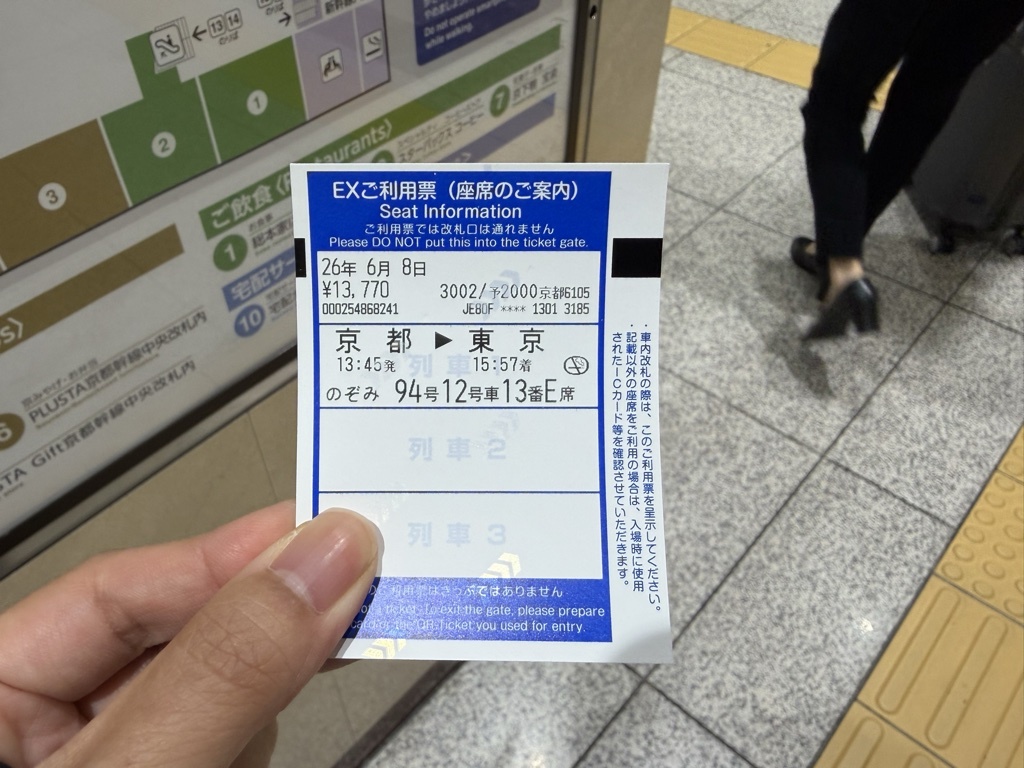
⚠️ A piece of paper comes out of the gate — what is it?
| Ticket type | What happens at the gate |
|---|---|
| Paper ticket (bought at machine or counter) | Insert ticket → collect it as it comes out. Seat number is printed on the ticket |
| IC card (via Smart EX, etc.) | Tap your IC card → a slip called “EXご利用票 (Seat Guide)” prints out automatically |
Where to Put Your Stroller and Luggage
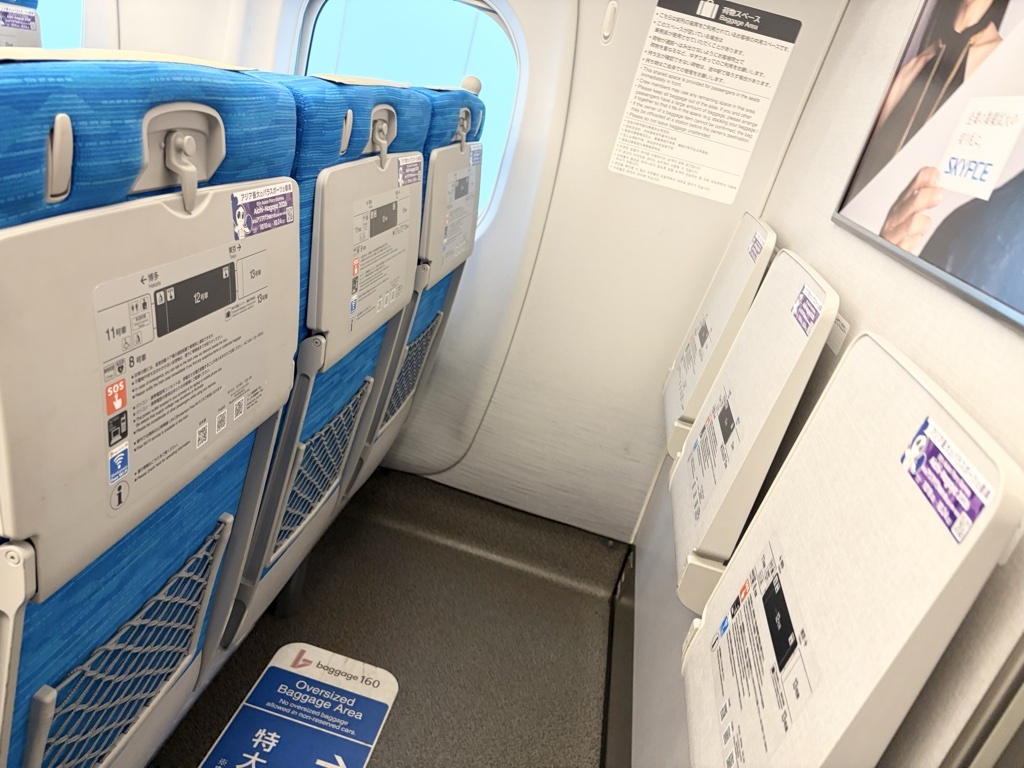
At the back of each car, behind the last row of seats, there’s an oversized luggage space where you can store a folded stroller or large suitcase.
Family-Friendly Features on the Shinkansen
Multipurpose Room (for nursing and diaper changes)
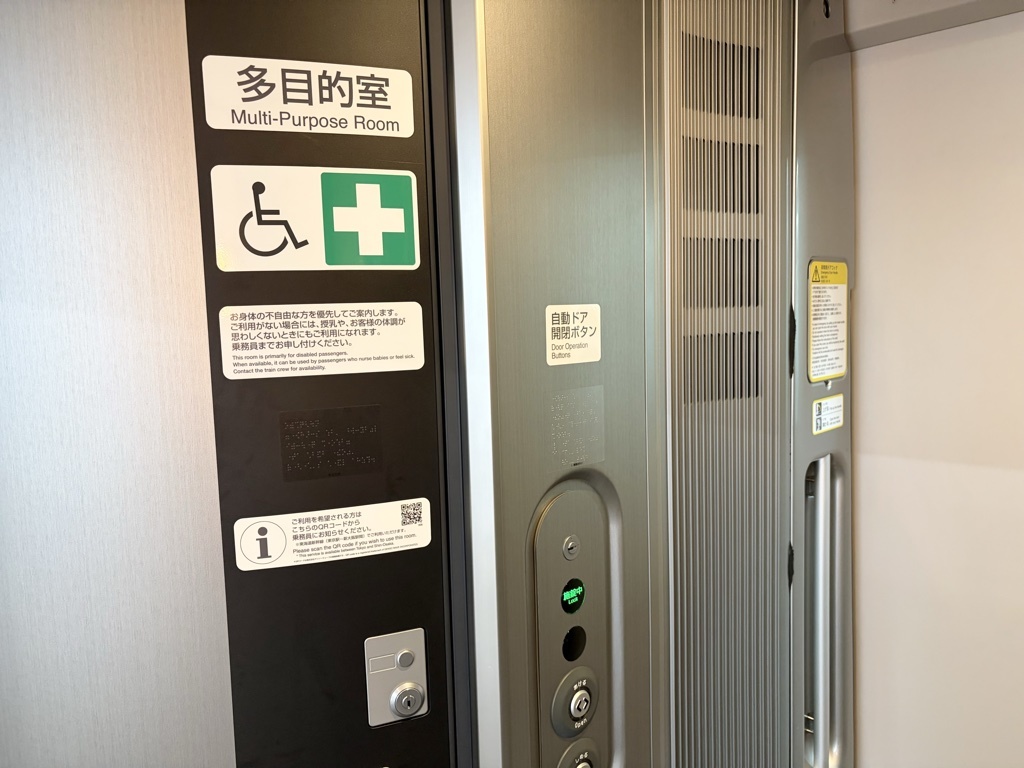
- Check the signs in each car after boarding to find the multipurpose room location (the car number varies by route and train type)
- It’s usually kept locked — ask the conductor if you’d like to use it
- Inside: fold-down changing table, seat for nursing, space for a stroller
Charging Ports
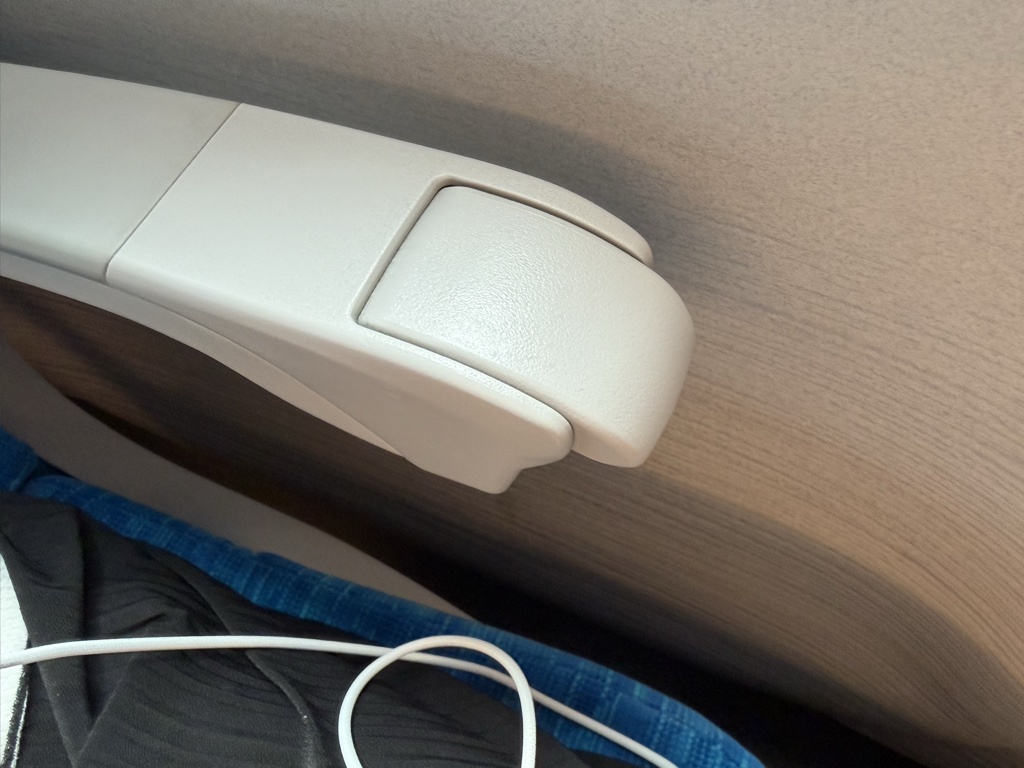
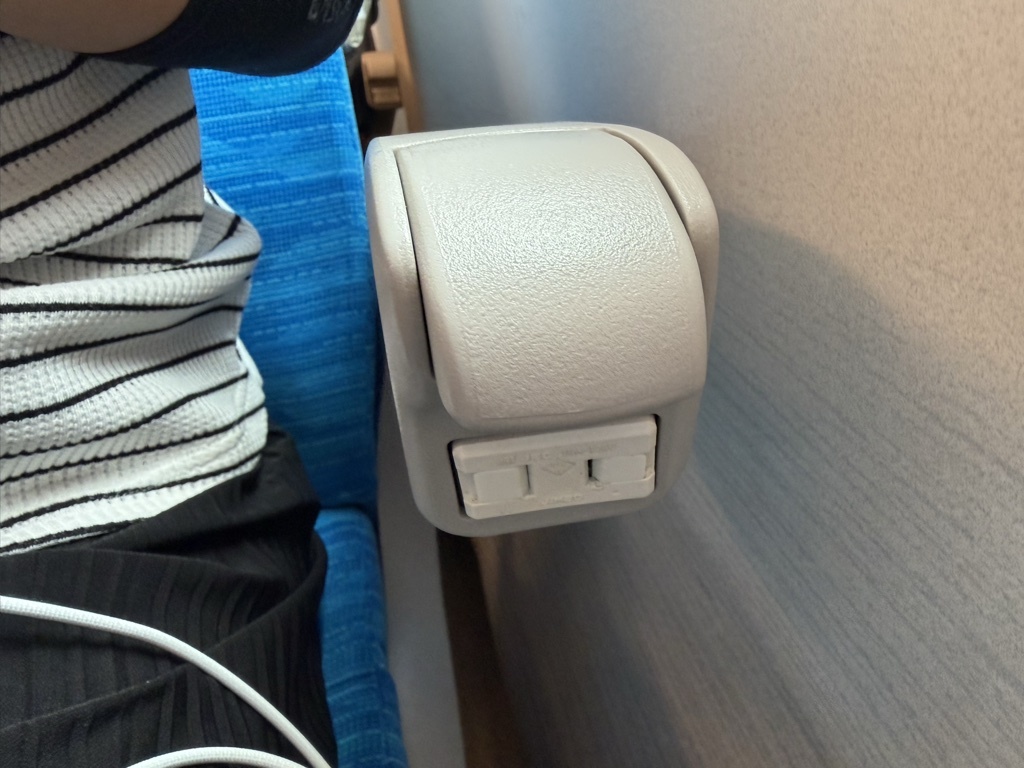
- Most Shinkansen seats (N700 series and newer) have power outlets at every seat or at the window seat
- Older trains may only have outlets at the ends of each row — check before you settle in
- Bring a small multi-plug adapter if you have multiple devices to charge
Onboard Wi-Fi
- Free Wi-Fi is available on most Shinkansen, but it can be slow and drops in tunnels
- For reliable streaming and app use (especially Disney+), your eSIM is more dependable
I always book the last row of a car for long rides — the wall behind you means no one reclines into your lap, and there’s a bit more room to wriggle. Kids appreciate it more than you’d expect.
Don’t Miss Your Stop
- Shinkansen stops are short — usually 1–3 minutes. Have your bags packed and your family ready before you pull in
- The station name is displayed on the platform screen and announced in both Japanese and English
- If you miss your stop, you’ll need to buy a new ticket for the next train back — it’s not the end of the world, but it’s stressful with kids
🚇 Subway Tips for Families — Tokyo & Osaka
Tokyo Subway
- Tokyo has two main subway operators: Tokyo Metro and Toei. They don’t share passes, so check which lines your route uses before buying
- IC cards (Suica or Pasmo) work on both — tap in, tap out, no need to buy individual tickets
- Most stations have elevators, but they’re not always obvious. Look for the blue wheelchair/elevator symbol on maps, or ask station staff
- Rush hour (7:30–9:30am, 5:30–8pm) is brutal. Avoid it with young kids if you possibly can
- Priority seating (silver seats) is reserved for elderly, pregnant, and passengers with young children — don’t hesitate to use it
Osaka Subway (Metro)
- Osaka Metro is simpler than Tokyo — fewer lines, clearer layout
- IC cards work here too (ICOCA is the local version, but Suica works fine)
- Key family-friendly lines: Midosuji Line (red) connects main sights; Chuo Line (green) goes to Osaka Aquarium (Kaiyukan)
- For USJ (Universal Studios Japan), take the JR Yumesaki Line (Loop Line → transfer at Nishikujo)
📱 Apps to Download Before You Go
| App | What it does | Why families need it |
|---|---|---|
| Google Maps | Navigation & transit routes | Shows train lines, transfers, walking time — works offline if you download the map |
| Google Translate | Real-time translation (camera mode) | Point your phone at any sign, menu, or ticket machine |
| Navitime Japan Travel | Detailed train schedules & fares | More precise than Google Maps for complex Shinkansen routes |
| IC Card app (Suica) | Mobile IC card | Add to Apple/Google Wallet — tap to pay without a physical card (iPhone works great in Japan) |
Download Google Maps offline for your destination cities before you leave home. Even with an eSIM, having an offline backup means you’re never stranded if the connection drops in a tunnel.
📱 See Japanese Punctuality in Action
You’ve probably heard that Japanese trains run on time. What’s harder to convey is how on time — we’re talking to the minute, every time, across thousands of daily services.
If you want to actually watch that happen, there’s a free iPhone app called Tokyo Glance that displays Tokyo’s trains, buses and aircraft moving across a live 3D map. Tap any train and you’ll see its current position and the exact minute it reaches each upcoming station.
🐻 Travel Mama Bear says: “Standing on the platform, you can pull up the train you’re waiting for and watch it approach in real time. Kids who love trains find this fascinating — and honestly, so do adults seeing Japanese rail precision for the first time.”
Free features include: the live 3D map, following individual trains, first and last train times, upcoming departures, live cameras, weather, and — usefully — service disruption and earthquake alerts. An optional Premium tier adds full station timetables and lock-screen tracking, but you don’t need it for any of the above.
⚠️ Not a route planner. For directions and transfers, use Google Maps. Tokyo Glance is for watching the network, not navigating it. It’s also iPhone only, and station names are searched in romaji.
👉 Tokyo Glance on the App Store (free)
🌐 tokyoglance.com — a web version is available too, so you can try it before you travel
※Not an affiliate link — we tried the app ourselves and thought it was worth sharing.
📶 Staying Connected — Your eSIM Options
Japan’s train system runs on digital tools — Google Maps, IC card apps, translation apps, live wait-time boards. You need a reliable data connection from the moment you land.
A Japan eSIM is the simplest option for most international visitors. No SIM swap, no waiting at the airport counter — you activate it before you leave home and it’s live when the plane touches down.
📊 How Much Data Do You Need?
| Trip length | Light use (maps + translate) | Heavy use (streaming + video calls) |
|---|---|---|
| 3–5 days | 3 GB | 5–10 GB |
| 1 week | 5 GB | 10–15 GB |
| 2 weeks | 10 GB | 20 GB+ |
Our family of 4 used 10 GB over 10 days — maps, Disney app, LINE calls, and evening hotel streaming. We had data to spare.
🐻 Our Secret Weapon: Tethering for Happy Kids on Long Rides
Here’s the tip that saves our family every single trip: Airalo’s eSIM supports tethering (personal hotspot). That means you can share your phone’s connection with your kids’ tablets.
A 2.5-hour Shinkansen ride from Tokyo to Osaka? Our kids watch YouTube or Disney+ the whole way, and the trip flies by. No downloaded-videos-running-out panic, no “are we there yet” every five minutes. 🐻
- 📱 One eSIM on a parent’s phone → connect the kids’ tablets via hotspot
- 🚄 We tested it on the Shinkansen, subways, and underground walkways — it works
- 💡 Choose a slightly bigger data plan (10 GB+) if the kids will be streaming
We ran real speed tests across Japan — on a moving Shinkansen, in underground stations, even at Tokyo Disney Resort. See all the actual numbers in our full review 👇

❓ Frequently Asked Questions
- QDo I need to fold my stroller on Japanese trains?
- A
There’s no law requiring it, but it’s considered good manners during crowded times. Outside of rush hour (avoid 7:30–9:30am and 5–8pm on weekdays), most passengers are happy to share the space. Look for train cars marked with the stroller/wheelchair symbol — they have designated spaces.
- QCan I use my IC card on the Shinkansen?
- A
Not on its own. Your IC card (Suica, ICOCA, etc.) works great on local trains, subways, and buses — but the Shinkansen requires a separate ticket. You can buy Shinkansen tickets at ticket machines at major stations (English menus available) or book in advance via Smart EX.
- QAre young children’s train fares free in Japan?
- A
On local trains and subways, children under school age (roughly under 6) ride free when accompanied by an adult (up to 2 per adult; the 3rd pays the child fare). Elementary school-age children (6–11) pay half the adult fare. If a young child occupies their own reserved seat on the Shinkansen, a child fare applies — but sitting on a parent’s lap is always free.
- QWhich IC card is best for tourists visiting Japan?
- A
iPhone users can set up Welcome Suica Mobile or Mobile ICOCA before leaving home — no airport queues needed. Android users arriving in Tokyo should pick up a Welcome Suica at Narita or Haneda; those arriving in Osaka/Kyoto should get an ICOCA at Kansai Airport. All cards work nationwide.
- QDo I need internet access to use trains in Japan?
- A
You don’t strictly need it — trains run on time without an app. But having reliable data makes a huge difference for navigation (Google Maps), translation, IC card apps, and staying in touch if you split up. We recommend an eSIM like Airalo — it activates before you land and works the moment you arrive.
🍼 Traveling Japan with a baby or toddler? These guides will save your trip:
🗺️ Ready to Explore
Japan’s train system can feel overwhelming at first glance — but once you’ve done it once, it clicks. The signs are clear, the trains are on time, and the staff are genuinely helpful even if you don’t share a language.
Your kids will probably think it’s the coolest part of the trip. Ours still talk about the Shinkansen.
🏨 Booked your trains? Now find the perfect family hotel:
👶 Traveling with a baby or toddler? These guides have you covered:
- 👉 Baby Essentials in Japan: Diapers, Formula & Baby Food
- 👉 Japan Packing List for Babies & Toddlers: Bring vs. Buy
- 👉 Nursing Rooms & Diaper Changing in Japan
- 👉 Japanese Convenience Stores: A Parent’s Survival Guide
You’ve got this. 🐻